Hey friends,
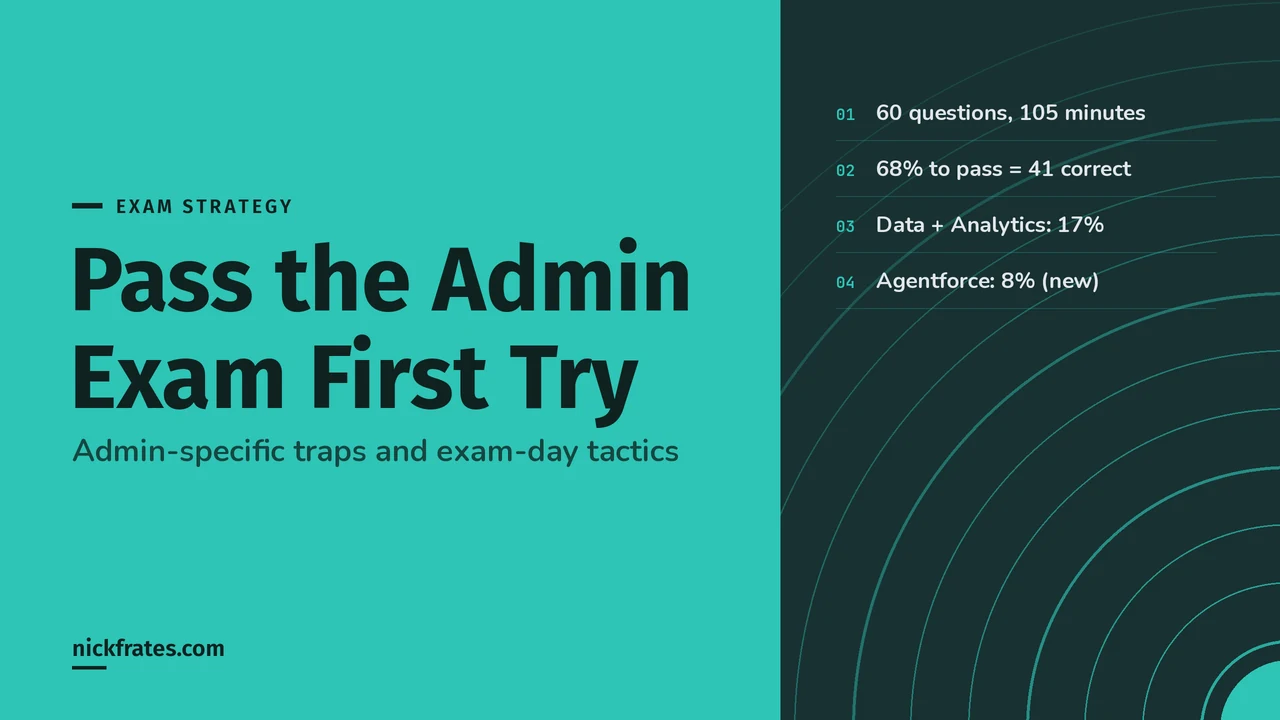
To pass the Salesforce Admin exam on your first try, you need 41 of 60 scored questions right (68%), so plan your study around the four biggest sections, learn the eight traps below cold, and take at least two timed 60-question practice runs before you book. That's the short version. The rest of this post is the long version, with the specific scenarios that trip people up.
I'm not going to repeat the basic exam facts here. If you want the cost, format and retake rules, read my Salesforce Admin certification guide. If you want every objective explained, use the Admin study guide. This post is only about one thing: not paying the $100 retake fee.
Cert Lab by Nick Frates
Start the free Admin Cert Lab
Lessons, practice questions and flashcards for the Salesforce Platform Administrator exam, in one free course.
Start the free Admin Cert Lab →The math: you can miss about 19 questions
The official exam guide says the exam has 60 scored questions plus up to five unscored ones, a 105-minute limit, and a 68% passing score in English. 68% of 60 is 40.8, so in practice you need 41 right. That means you can miss about 19.
That number changes how you study. You don't need to be perfect anywhere. You need to be solid in the big sections and not fall apart in any one of them.
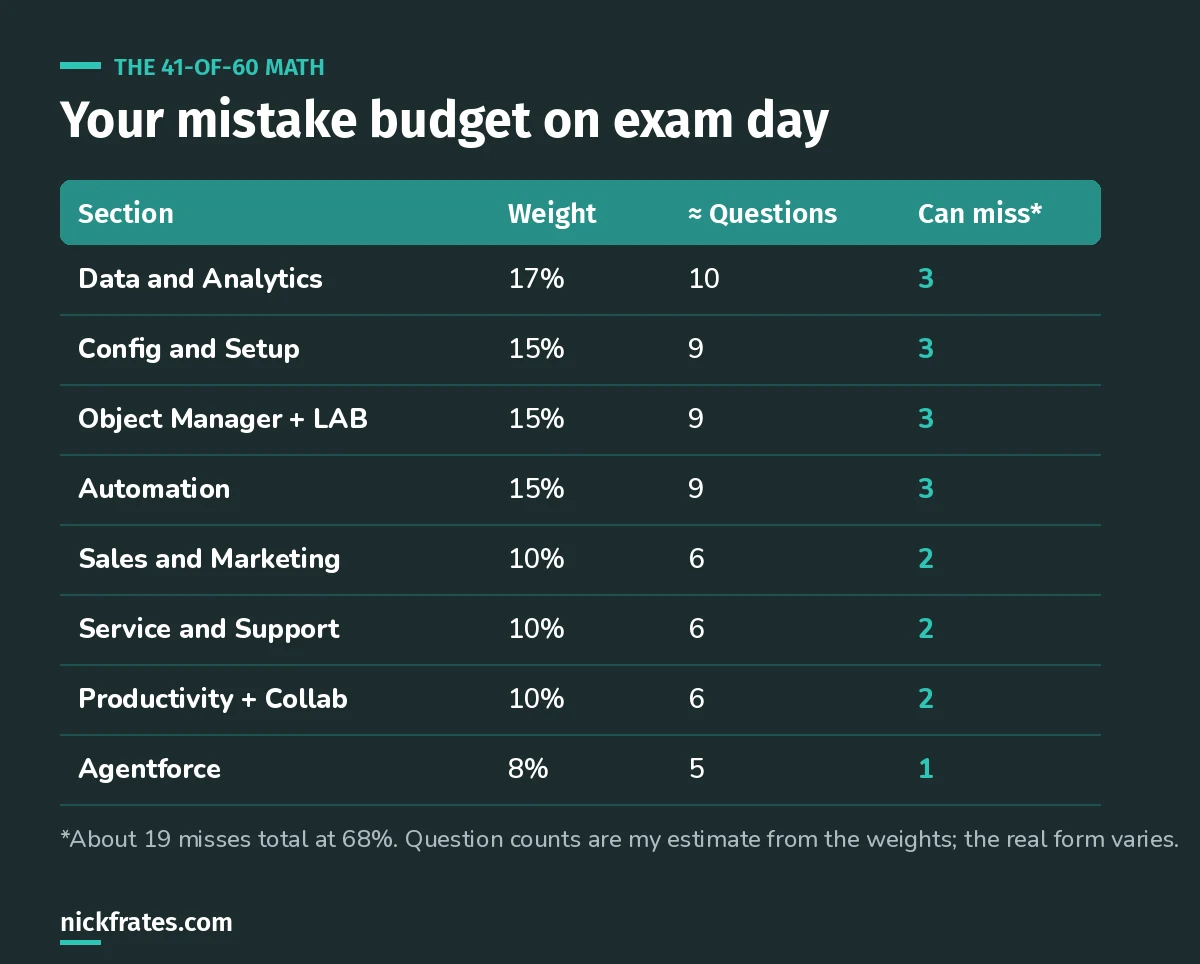
My estimate of the questions per section, from the official weights. The exam doesn't publish per-section counts.
Some questions ask you to pick more than one answer and tell you how many, like "Choose 2". Read that number in the stem every time; it's an easy point to throw away.
Study the 2026 outline, not an old one
Salesforce refreshed the Admin exam on December 15, 2025. The Salesforce Admins blog post about the update explains the new weights and the new Agentforce section. A lot of free material online still teaches the old outline, so check the date on anything you study.
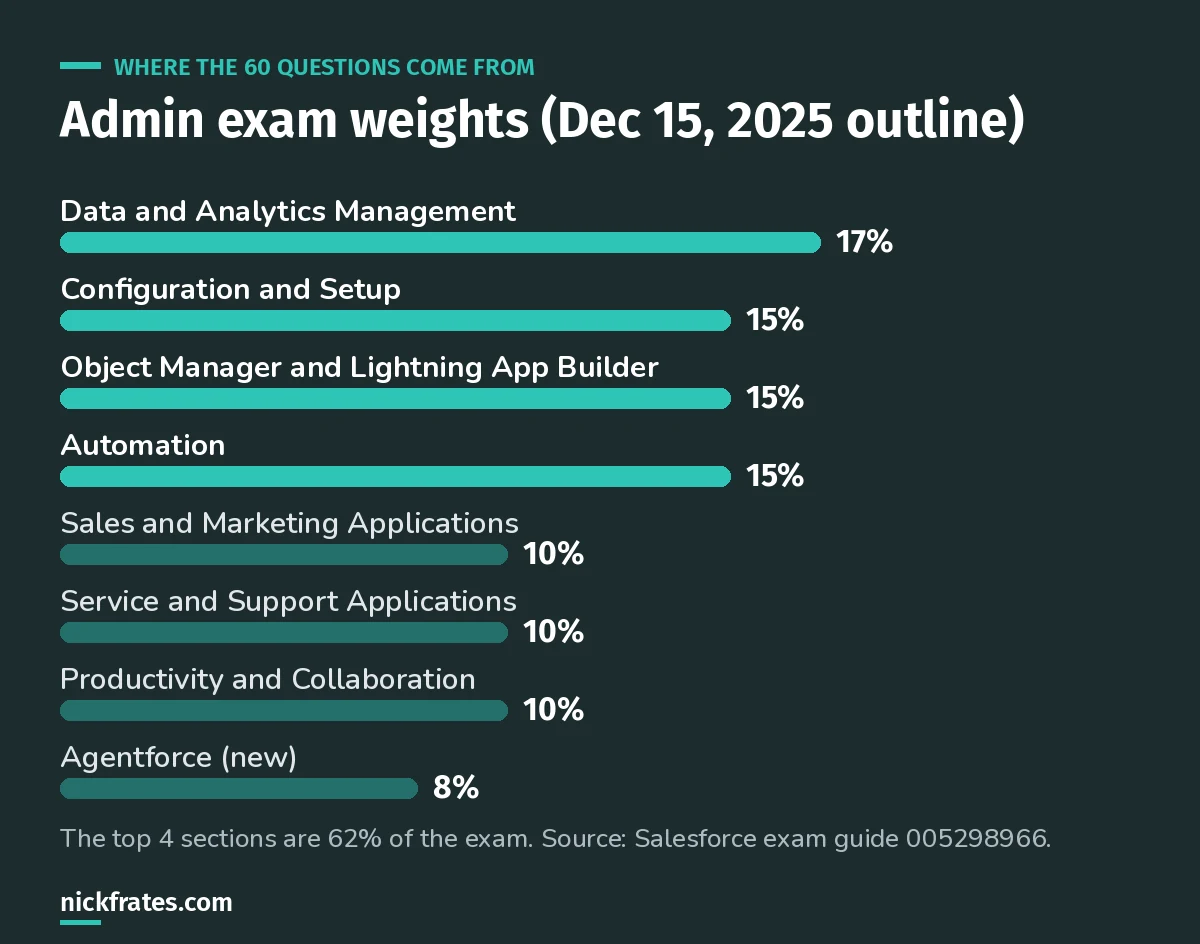
The eight sections of the current Admin exam outline.
Two things stand out. Data and Analytics Management is now the biggest single section at 17%. And Agentforce is 8%, which is about five questions. The Admins blog is clear that this doesn't mean you need to be an Agentforce expert. Know the basics well and spend your real time on the 15% and 17% sections.
8 Admin-specific traps (with worked examples)
These come straight from wording in the official objectives. When the guide names a detail like "not deleting a user" or "muting", expect a scenario question built around it. The examples are my own, not real exam questions.
Trap 1: Deleting a user.
The objective literally says "not deleting a user". You can't delete users in Salesforce. You deactivate them (or freeze them first if deactivating would break something, like an open approval or a default owner setting).
Worked example: A sales rep quits on Friday. She owns 300 open opportunities and is the default lead owner in a lead assignment rule. Your manager asks you to "delete her today". The right sequence is freeze now to block login, reassign her records and fix the assignment rule, then deactivate. Any answer choice that says "delete the user" is wrong on sight. For more sales and service setup, see my Sales and Service apps cheat sheet.
Trap 2: Deleting a field that something depends on.
The guide calls out roll-up summaries, cross-object formulas, picklist dependencies and relationship fields. When a question asks what happens if you delete a field, the trap answer is usually "it deletes cleanly". Think about what references it first.
Worked example: You want to delete a custom field Region__c. A formula on Opportunity reads Account.Region__c. Salesforce blocks the delete until you remove the reference. The question will hide that formula in the second sentence of the scenario.
Trap 3: Profile vs permission set vs permission set group with muting.
Profiles are the baseline. Permission sets add access on top. Permission set groups bundle several sets, and a muting permission set inside a group takes away a permission the group would otherwise grant. If a question says "give everything in this group except export", muting is the answer, not a new profile.
Trap 4: Sharing that opens up instead of locks down.
Org-wide defaults set the most restrictive baseline. Roles, sharing rules, teams and manual sharing can only open access up from there. When a scenario asks you to restrict one group of users, the answer is almost never a sharing rule. Look at the org-wide default, the profile or permission set, or field-level security instead. My Salesforce security model guide covers each layer in more depth.
Worked example: Org-wide default for Case is Public Read Only. Support managers want agents to stop seeing VIP cases. You can't do that with a sharing rule. You set the OWD to Private, then open access back up with the role hierarchy and sharing rules for everyone who should see non-VIP cases.
Trap 5: Reports that show different numbers to different people.
The sharing model applies to reports. Two users running the same report can see different totals because they can see different records. Report and dashboard folders control who can see the report itself, not the records inside it. Dynamic dashboards run as the viewer; a normal dashboard runs as one fixed user.
Trap 6: Picking the wrong automation tool.
The automation objective lists escalation rules, assignment rules, Flow, approval processes, the default automation user and AI. A good habit is to name the job first: routing a new case is an assignment rule, "nobody touched this case in 4 hours" is an escalation rule, "manager signs off on a discount" is an approval, and anything with real logic is Flow. Process Builder and Workflow Rules are retired, so don't pick them. For more on the Flow side, see my guide to Salesforce Flow for the Admin exam.
Trap 7: Data Loader vs Data Import Wizard, and duplicate vs validation rules.
Import Wizard is the in-browser tool for smaller, simpler loads with built-in duplicate matching for some standard objects. Data Loader is the tool for big loads, more objects, export and delete. Duplicate rules decide what counts as a duplicate record; validation rules decide what counts as bad data in a single record. Questions love to blur these.
Trap 8: Agentforce questions that are really about access.
The Agentforce objective mentions "troubleshooting agent permissions", prompts and instructions in Agent Builder, and conversation preview. Treat these like any other admin question. If the agent can't do something, the first suspects are its permissions and its instructions, and you test changes in the conversation preview before you roll them out.
Exam-day tactics to pass the Salesforce Admin exam
- Do a first pass in about 60 minutes. Answer what you know, flag anything that takes more than about a minute and a half, and move on. 105 minutes for 65 questions is around a minute and a half each.
- Read the last sentence first. Long scenarios bury the actual question at the end. Read it, then read the scenario looking only for what matters.
- Circle the constraint words. "Without code", "minimum access", "most efficient" and "restrict" decide between two otherwise good answers.
- Eliminate retired features. Process Builder, Workflow Rules and Classic-only answers are rarely right on a 2026 exam.
- Never leave a blank. A blank can't be right, so make sure every question has an answer before time runs out.
- Don't chase the unscored questions. Up to five are unscored and mixed in at random. If one looks bizarre, it might not count. Make your best guess and keep moving.
Online or test center: avoid an automatic fail
You book through Trailhead Academy, and the exam is delivered by Pearson VUE, either at a test center or online. The name on your booking has to match your government ID. If the exam fee is a hurdle, here's how to get Salesforce Admin certified for free.
If you test online, the Pearson VUE OnVUE page for Salesforce is strict. A few rules that catch people:
- One display only. Unplug or cover extra monitors.
- No headphones or earbuds, and no phone, watch or smart glasses in reach.
- No VPNs, corporate networks or public networks. Testing on a locked-down work laptop is a common way to fail the check.
- Run the official system test on the same computer and network you'll use on exam day.
- Failing the technical requirements can cancel your exam and forfeit your fee.
Salesforce's candidate code of conduct also bans notes, paper, food and drinks during an online exam, and you must stay in view of the camera. If your home setup is shaky, book a test center.
Am I ready? A simple go or no-go test
Book the exam when all three of these are true:
- You've scored 75% or higher on two different timed 60-question practice exams, taken a few days apart.
- No single section is below about 60% in your practice results.
- You can explain each of the eight traps above to a friend without notes.
I use 75% instead of 68% because practice scores tend to drop a little under real exam pressure. My free Admin practice test is a good first check, and the exam score calculator shows where your practice scores leave you.
One rule that isn't optional
Don't use exam dumps or "real question" sites. Salesforce's code of conduct bans using or sharing exam content, including through unauthorized study sites, and the penalties include losing your certifications and a ban from testing. Dumps are also often wrong. Practice questions written from the official objectives are the safe way to prep. Penalties can include losing your Salesforce Certified Administrator credential.
After you pass
Your certification stays active only if you complete the yearly maintenance module on Trailhead. The maintenance rules are on Salesforce Help. Put a reminder in your calendar the day you pass.
Cert Lab by Nick Frates
Practice the traps for free
The free Admin Cert Lab has short lessons, original practice questions with explanations for every option, and flashcards. All 8 exam sections are live.
Start the free Admin Cert Lab →Keep studying
- Salesforce Admin certification: cost, format and who it's for
- Salesforce Administrator study guide: every objective explained
- 25 free Admin practice questions
- 6-week Admin study plan for people with full-time jobs
- All my Salesforce certification study guides
Hope this helps, and good luck on the exam!
Best,
Nick


